
Albert Einstein
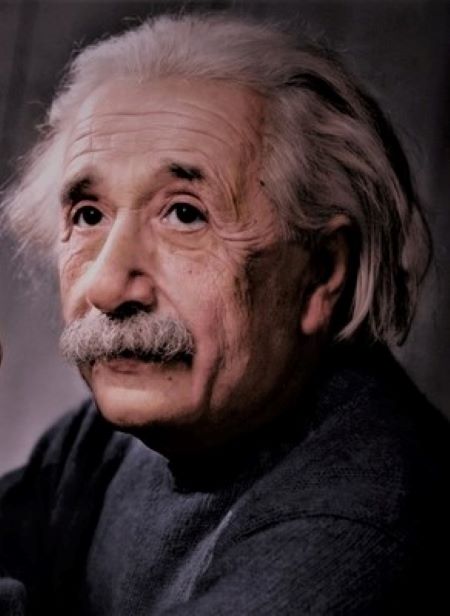
Albert Einstein was a German-born theoretical physicist who developed the theory of relativity, one of the two pillars of modern physics. His work is also known for its influence on the philosophy of science.
Mar 14, 1879
Albert Einstein Born
Albert Einstein is born in Ulm, Germany, the son of Hermann Einstein, a German-Jewish featherbed salesman, and his wife Pauline.
1896
Einstein at ETH
Albert Einstein graduates from high school and begins attending ETH, the prestigious Swiss Polytechnic University in Zurich.
1900
College Graduation
Albert Einstein graduates from ETH with a degree in physics. He tries to find a teaching job, but is unable to obtain work.
1902
Swiss Patent Office
Unable to find any work as a teacher or academic, Albert Einstein takes a job as a clerk at the Swiss Patent Office.
1905
Annus Mirabilis
Over the course of a year that he will later describe as his "Annus Mirabilis"—his miraculous year—Albert Einstein publishes four major theoretical papers in the prestigious German academic journal Annalen Der Physik. The four papers include a groundbreaking new interpretation of the photoelectric effect (for which Einstein will eventually win the Nobel Prize) as well as the first published exploration of the theory of Special Relativity and the first formulation of the famous equation e=mc2.
1914
Director of Kaiser Wilhelm Institute
Albert Einstein moves to from Zurich to Berlin to become the director of the prestigious Kaiser Wilhelm Institute. His marriage to Milena begins to unravel, and his wife and children decide to stay behind in Zurich. They will never live together as a family again.
1915
General Theory of Relativity
Einstein completes his General Theory of Relativity.
Eclipse Proves Theory of Relativity
A solar eclipse provides dramatic observable evidence that Einstein's General Theory of Relativity is correct. Einstein suddenly becomes a worldwide celebrity.
1921
Nobel Prize
Albert Einstein wins the Nobel Prize in Physics for his work on the photoelectric effect, first published in 1905.
1933
Escape from Nazi Germany
Albert Einstein and his family, fearing anti-Semitic persecution, flee from Nazi Germany to resettle in the United States. Einstein takes a post at Institute of Advanced Study at Princeton, where he will remain until his death in 1955.
1939
Letter to President Roosevelt
Fearing that Nazi scientists might win the race to develop the world's first atomic bombs, Albert Einstein writes a letter to President Franklin D. Roosevelt, urging him to launch an American program of nuclear research.
1940
US Citizenship
For the third time in his life, Albert Einstein changes his nationality, becoming a United States citizen while also retaining his Swiss citizenship.
Apr 18, 1955
Death of Albert Einstein
Albert Einstein dies of heart failure at the age of 76.
.png)


